How it works
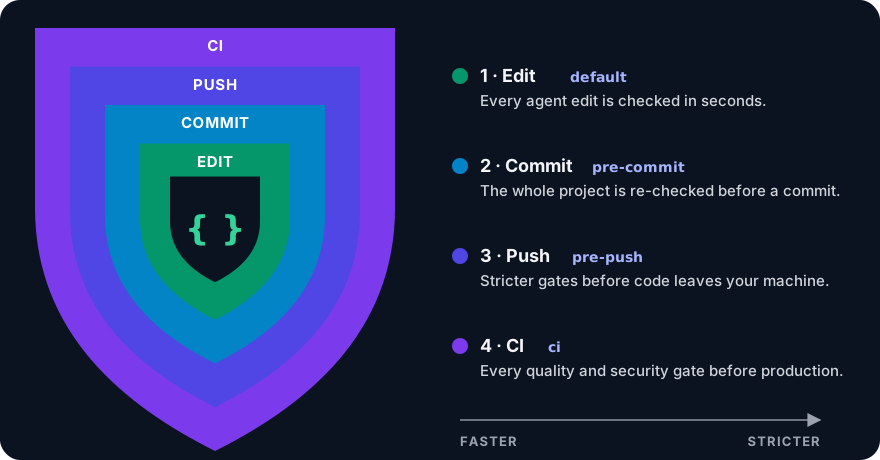
AI coding agents write code faster than anyone can review it. Without guardrails, you repeat the same rules in every prompt, and the agent still forgets some of them. Ward keeps those rules in the repository and checks them at four moments, so the agent gets precise feedback early and nothing it missed reaches production.
The four layers
Section titled “The four layers”Each layer is a profile in ward.toml. Inner layers are fast so
they can run constantly; outer layers are stricter and slower.
| Layer | Profile | When it runs | Set up with |
|---|---|---|---|
| 1. Edit | default | After every agent edit or write | ward init --integration <agent> or ward integrate |
| 2. Commit | pre-commit | Before each git commit | ward init --quality-hooks |
| 3. Push | pre-push | Before each git push | ward init --quality-hooks |
| 4. CI | ci | In your CI pipeline | ward init --ci github or the CI/CD guide |
1. Edit
Section titled “1. Edit”After the agent edits or writes a file, its hook runs ward check on the edited files and returns
the result to the agent. A failure includes the file, line, and rule, so the agent can fix it in the
same turn without you explaining the rule. Only fast checks belong here, such as formatting,
Checkstyle, and PMD. See Claude Code, OpenCode,
and other agents.
2. Commit
Section titled “2. Commit”The pre-commit hook runs the same fast checks on the staged files, including a secret scan of
those files. It catches what the edit layer
can’t see: files changed outside the agent, by a person, or by a tool. See
quality hooks.
3. Push
Section titled “3. Push”The pre-push hook adds slower local checks before code leaves your machine: compilation, tests,
coverage, SpotBugs, and, with the strict preset, ArchUnit architecture rules and Maven Enforcer.
CI runs every configured gate, including slow ones such as PIT mutation testing and the ones that need network access, a running application, or a baseline, such as Trivy, Semgrep, OWASP Dependency-Check, SonarQube, and OWASP ZAP. This is the last check before production.
Layers are cumulative
Section titled “Layers are cumulative”ward init puts each gate in the first layer it fits and in every layer after it, so the outer
layers always include the inner ones. The bare ward check runs the same checks as pre-commit.
To move a gate, edit its profiles list:
[quality-gates.spotbugs]command = "./mvnw spotbugs:check"profiles = ["pre-push", "ci"] # not on every edit or commitWhy it saves time and tokens
Section titled “Why it saves time and tokens”- The project explains the rules, not you. The agent learns about a broken rule from a failing check, at the moment it breaks it, instead of from a long prompt.
- Mistakes are fixed while they are small. A finding on the edited file is cheaper to fix than a failed review or CI run hours later.
- Repeated mistakes become rules. With learning, a recurring finding
asks the agent to write a preventive rule in
AGENTS.md.
Set it up with your agent
Section titled “Set it up with your agent”The agent skills let your coding agent set up the layers with you:
ward-init chooses the preset, gates, agent integration, and Git hooks for the project,
ward-tune fits the rules to your real code, and ward-fix fixes the code until the gates pass.
Share it with your team
Section titled “Share it with your team”Commit ward.toml, the rule files under config/, the generated agent hooks (such as .claude/
or .opencode/), and, if you generate it, AGENTS.md. Every teammate and every agent then works with
the same rules. The commit and push hooks live in .git/hooks/, which Git doesn’t share; a one-step
setup for teammates is planned.